
Security Insync Phish Threat
Summary: Phish Threat
Download article(s)
 Insync-sophos-phish-threat-ds.pdf
dont-take-the-bait-wp-en.pdf
Insync-sophos-phish-threat-ds
dont-take-the-bait-wp-en
Highlights
Ì Over 500 email threat
templates and 60 engaging
training modules
Ì Report simulated attacks with
the Outlook add-in for PC and
Mac
Ì Automated reporting on
phishing and training results
Ì 10 language options
Ì Choice of international hosting
regions (United States, UK,
Germany)
Information security is only as good as your weakest link
Phishing is big business. Attacks have shown record growth in recent years, with 66% of
malware now installed via malicious email attachments, and advanced spear phishing
attacks costing businesses an average of $140,000 per incident. Users continue to be the
easiest target for attackers in the cybersecurity defenses of most organizations, but an
army of trained, phishing-aware employees can provide you with a human firewall against
these threats.
Sophos Phish Threat emulates a range of phishing attack types to help you identify
areas of weakness in your organization’s security posture, and empower users through
engaging training to strengthen your organizations defenses.
The freshest campaigns
Simulate over 500 realistic and challenging phishing attacks in a just few clicks.
At Sophos, our global SophosLabs analysts monitor millions of emails, URLs, files, and
other data points each day for the latest threats. This constant stream of intelligence
ensures user training covers current phishing tactics, with socially relevant attack
simulation templates, covering multiple scenarios and translated into 10 languages:
Ì English
Ì German
Ì French
Ì Dutch
Ì Italian
Ì Spanish
Ì Portuguese
Ì Korean
Ì Japanese
Ì Traditional
Chinese
Access a continually growing library of international templates from beginner to expert
Sophos Phish Threat
Reduce your largest attack surface
Attackers relentlessly target organizations with spam, phishing, and
advanced socially engineered attacks, with 41% of IT professionals
reporting phishing attacks at least daily. Your end users are often an easy
target and the weakest link in your cyber defenses. Keep your users – and
business – safe with effective phishing simulations, automated training, and
comprehensive reporting from Sophos Phish Threat.
Sophos Phish Threat
United Kingdom and Worldwide Sales
Tel: +44 (0)8447 671131
Email: sales@sophos.com
North American Sales
Toll Free: 1-866-866-2802
Email: nasales@sophos.com
Australia and New Zealand Sales
Tel: +61 2 9409 9100
Email: sales@sophos.com.au
Asia Sales
Tel: +65 62244168
Email: salesasia@sophos.com
© Copyright 2022. Sophos Ltd. All rights reserved.
Registered in England and Wales No. 2096520, The Pentagon, Abingdon Science Park, Abingdon, OX14 3YP, UK
Sophos is the registered trademark of Sophos Ltd. All other product and company names mentioned are
trademarks or registered trademarks of their respective owners.
Try it free for 30 days
Register for your free 100-user evaluation at
sophos.com/phish-threat.
22-11-07 DS-EN (PC)
Effective training modules
Over 60 interactive training modules will educate users
about specific threats, such as suspicious emails, credential
harvesting, password strength, and regulatory compliance.
Available in a choice of 10 languages, your end users will find
them informative and engaging, while you’ll enjoy peace of
mind when it comes to future real-world attacks:
Engage users with a selection of interactive training modules
Comprehensive reporting
Understand your organization’s security health and
demonstrate real return on investment with intuitive
dashboard results on demand. The Phish Threat dashboard
provides at-a-glance campaign results on user susceptibility,
and allows you to measure overall risk levels across your
entire user group with live Awareness Factor data, including:
Ì Top level campaign results
Ì Organizational trend of caught employees and reporters
Ì Total users caught
Ì Testing coverage
Ì Days since last campaign
Drill–down reports will give you deeper insight into
performance at an organizational, or individual user level.
The included Outlook add-in provides users with the ability to
report simulated attacks right from the inbox – allowing you
to track true awareness at the inbox, providing new insight
into your organization-wide security posture.
Interactive reports measure overall risk level and user performance
Phish Threat is part of Sophos Central
Available to your entire IT organization through a single pane
of glass, Phish Threat is part of Sophos Central, our cloud-
based unified security console. This means no hardware or
software to install, and you benefit from the only solution
enabling the management of phishing simulations and user
training, alongside security for email, endpoint, mobile and
much more. You get a single, up-to-date, Sophos-hosted
platform that’s simple and intuitive. Find out more at sophos.
com/central.
Getting started is easy
Sophos Phish Threat is conveniently run entirely through your
web browser. To ensure Phish Threat emails are successfully
delivered, simply whitelist the IP addresses provided in your
Sophos Central console along with the email addresses and
domains used in your Phish Threat campaigns. Then simply
import users, either via CSV file or using the handy Active
Directory synchronization tool. Once your users have been
uploaded, you’re ready to send your first campaign.
How to buy
Priced per user with bands from one to 5,000-plus, Sophos
Phish Threat’s single license type keeps things simple, with
unlimited tests per user, so you can focus on protecting your
users – and business – safe from today’s advanced phishing
attacks.
A Sophos Whitepaper July 2019
Don’t Take the Bait
Phishing is big business. Don’t get hooked.
In the last year, phishing attacks have seen a meteoric rise as
attackers continue to refine tactics and share successful types of
attacks. In particular, they’ve taken advantage of the malware-as-a-
service offerings on the dark web in order to increase the efficiency
and volume of attacks. In fact, 41% of organization now report at
least daily phishing attacks.¹
In this paper, we’ll dive into the evolution of phishing in recent
years, how it works, and what it looks like. And as cybercriminals
continue to prey on employees through their technology, we’ll make
an argument for the importance of a multi-layered defense against
phishing attacks: combining advanced security technologies with
educated, phishing-aware employees.
Don’t Take the Bait
2
A Sophos Whitepaper July 2019
More than annoying spam
Traditionally phishing was associated with online banking cybercrimes: crooks
send an email luring you to a website that’s a visual clone of your bank’s login page, where
you enter your credentials into a phony form and drop them right into the criminals’ laps.
But phishing covers much more than just fake banking sites and links to life-enhancing pills
or package deliveries: it’s really just about dangling bait in front of you and waiting for you to
swallow it, providing them with useful and valuable information.
Phishing is big business
In recent years, the volume of phishing attacks has grown dramatically, fuelled by dark web
services such as free phishing kits and phishing-as-a-service. It’s become increasingly
simple for even the least technically inclined attacker to leverage advanced malware that’s
been produced by someone far savvier than they are.
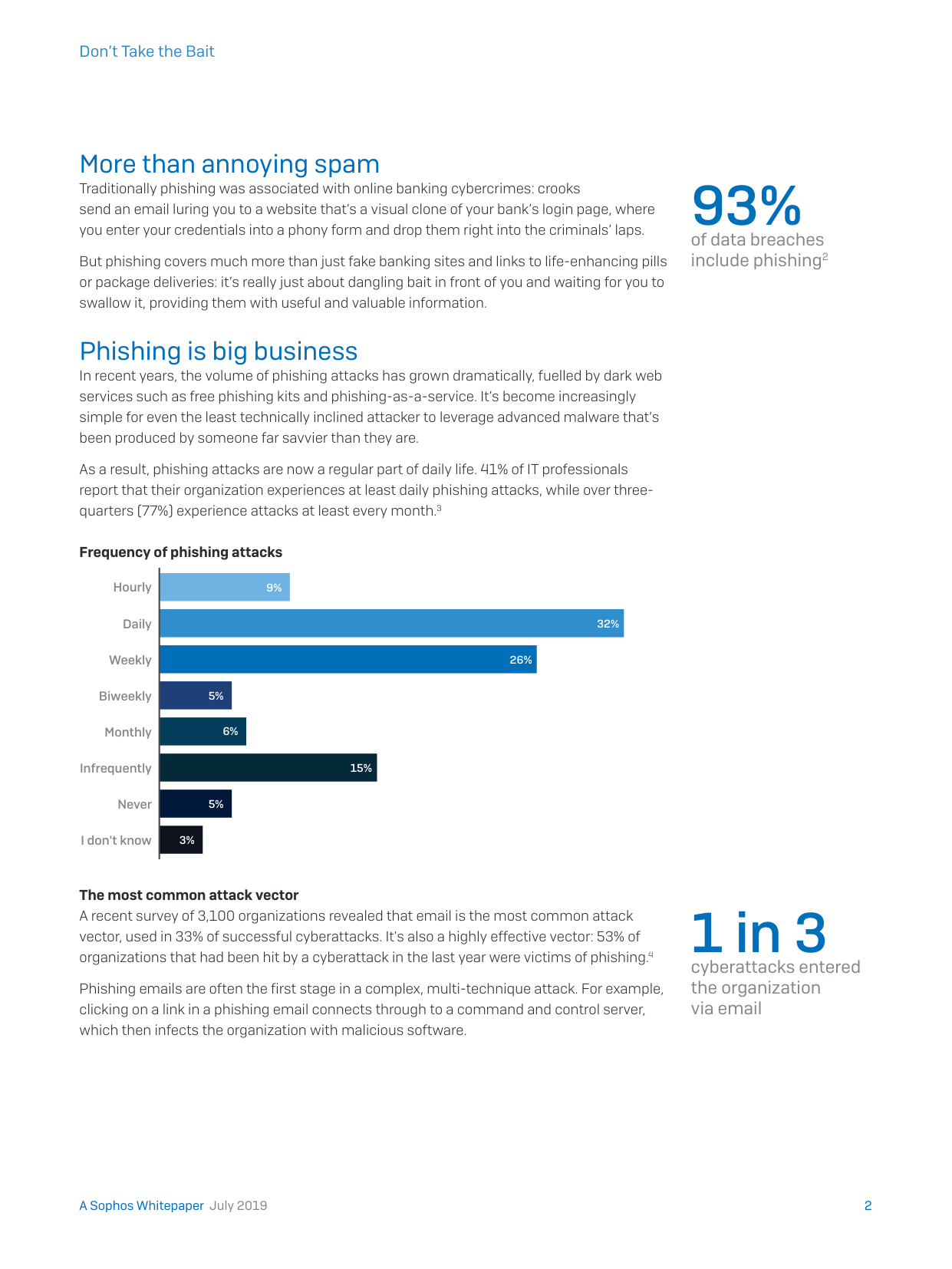
As a result, phishing attacks are now a regular part of daily life. 41% of IT professionals
report that their organization experiences at least daily phishing attacks, while over three-
quarters (77%) experience attacks at least every month.3
Frequency of phishing attacks
6%
Monthly
15%
Infrequently
5%
Never
3%
I don't know
Biweekly
5%
Weekly
26%
Daily
32%
Hourly
9%
The most common attack vector
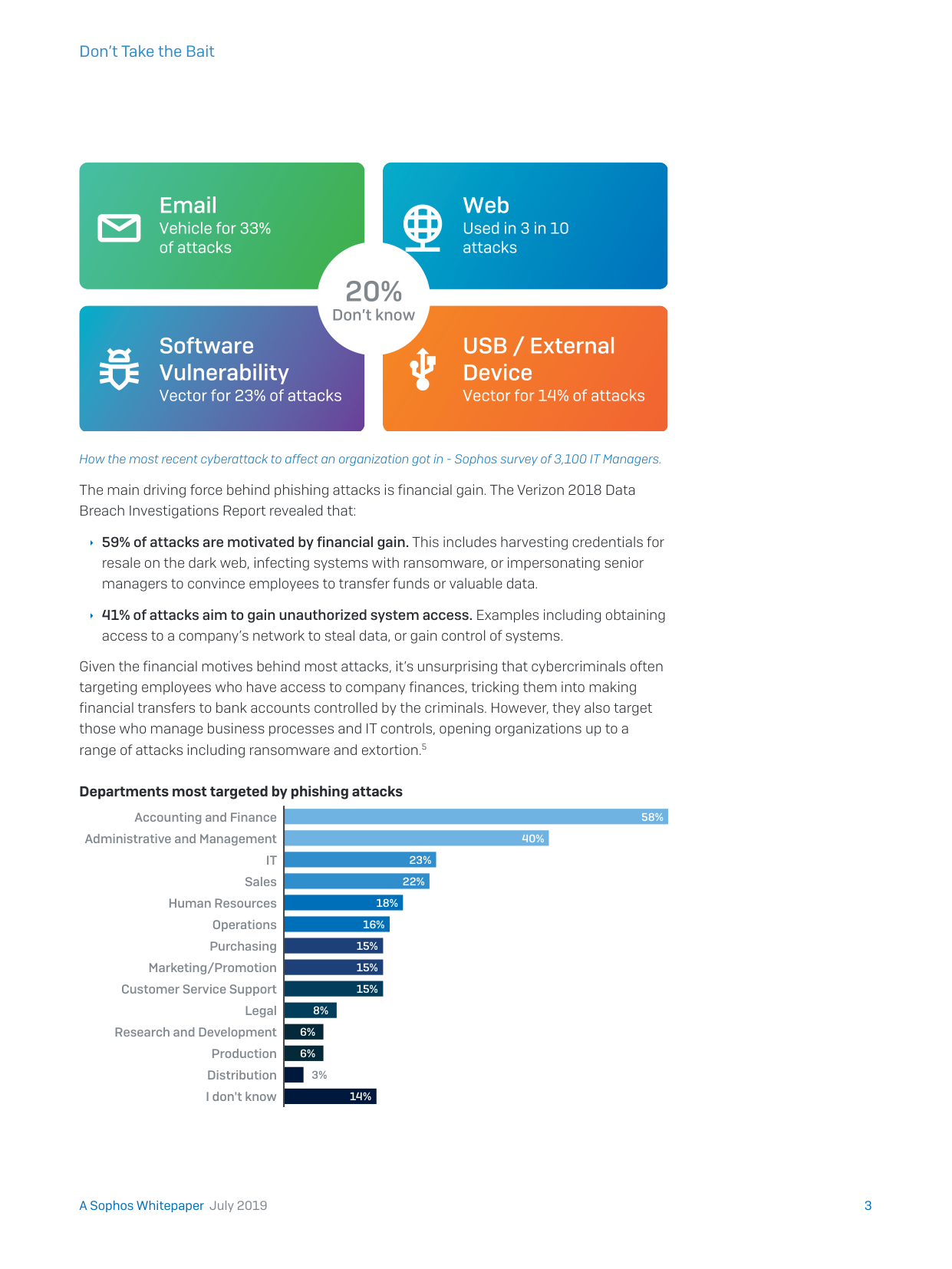
A recent survey of 3,100 organizations revealed that email is the most common attack
vector, used in 33% of successful cyberattacks. It's also a highly effective vector: 53% of
organizations that had been hit by a cyberattack in the last year were victims of phishing.4
Phishing emails are often the first stage in a complex, multi-technique attack. For example,
clicking on a link in a phishing email connects through to a command and control server,
which then infects the organization with malicious software.
93%
of data breaches
include phishing2
1 in 3
cyberattacks entered
the organization
via email
Don’t Take the Bait
3
A Sophos Whitepaper July 2019
How the most recent cyberattack to affect an organization got in - Sophos survey of 3,100 IT Managers.
The main driving force behind phishing attacks is financial gain. The Verizon 2018 Data
Breach Investigations Report revealed that:
Ì 59% of attacks are motivated by financial gain. This includes harvesting credentials for
resale on the dark web, infecting systems with ransomware, or impersonating senior
managers to convince employees to transfer funds or valuable data.
Ì 41% of attacks aim to gain unauthorized system access. Examples including obtaining
access to a company’s network to steal data, or gain control of systems.
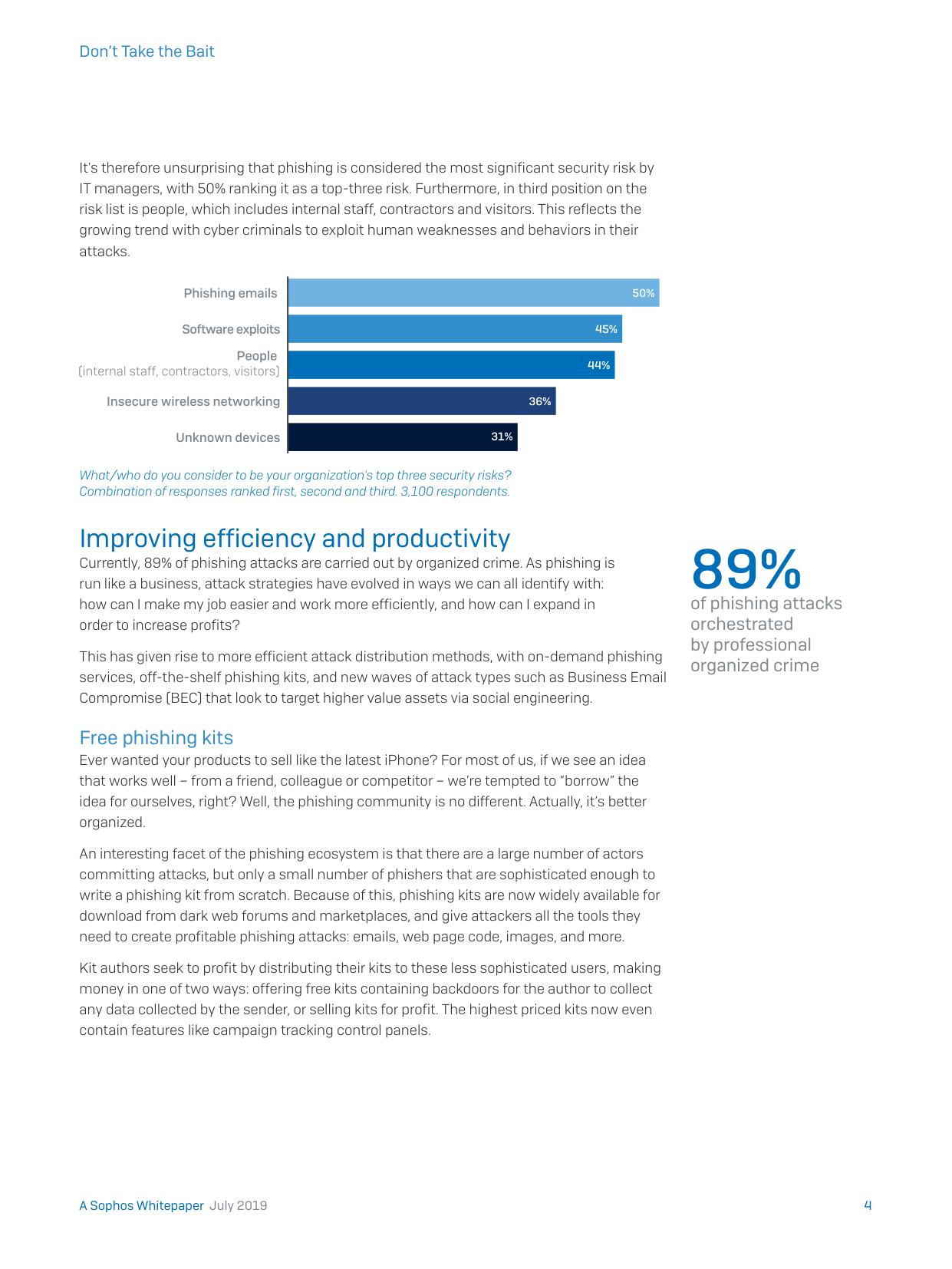
Given the financial motives behind most attacks, it’s unsurprising that cybercriminals often
targeting employees who have access to company finances, tricking them into making
financial transfers to bank accounts controlled by the criminals. However, they also target
those who manage business processes and IT controls, opening organizations up to a
range of attacks including ransomware and extortion.5
Departments most targeted by phishing attacks
18%
Operations
16%
Purchasing
15%
Marketing/Promotion
15%
Customer Service Support
Human Resources
22%
Sales
23%
IT
40%
Administrative and Management
58%
Accounting and Finance
Research and Development
Production
Distribution
I don't know
Legal
6%
6%
3%
14%
8%
15%
Don’t Take the Bait
4
A Sophos Whitepaper July 2019
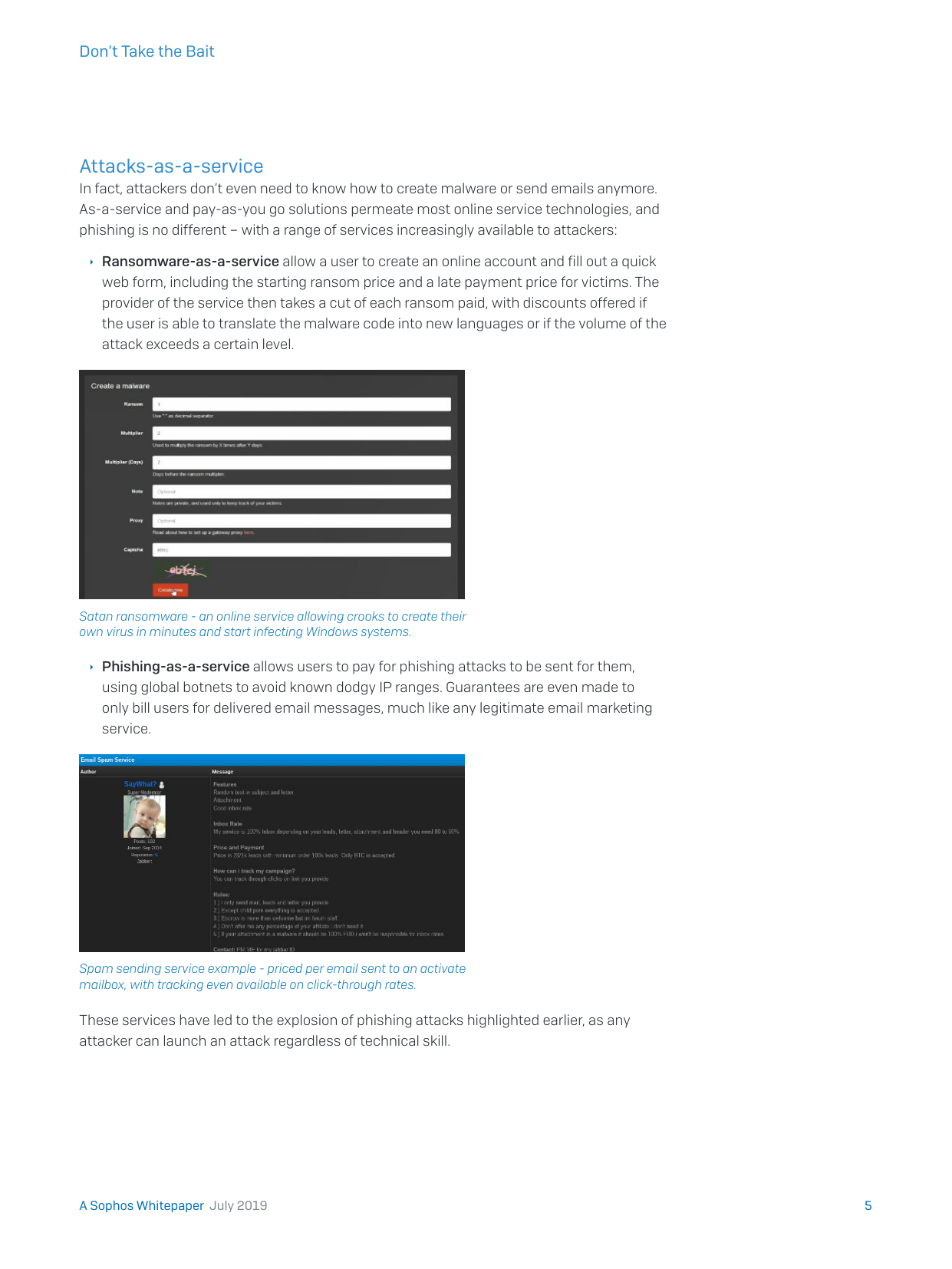
It's therefore unsurprising that phishing is considered the most significant security risk by
IT managers, with 50% ranking it as a top-three risk. Furthermore, in third position on the
risk list is people, which includes internal staff, contractors and visitors. This reflects the
growing trend with cyber criminals to exploit human weaknesses and behaviors in their
attacks.
What/who do you consider to be your organization's top three security risks?
Combination of responses ranked first, second and third. 3,100 respondents.
Improving efficiency and productivity
Currently, 89% of phishing attacks are carried out by organized crime. As phishing is
run like a business, attack strategies have evolved in ways we can all identify with:
how can I make my job easier and work more efficiently, and how can I expand in
order to increase profits?
This has given rise to more efficient attack distribution methods, with on-demand phishing
services, off-the-shelf phishing kits, and new waves of attack types such as Business Email
Compromise (BEC) that look to target higher value assets via social engineering.
Free phishing kits
Ever wanted your products to sell like the latest iPhone? For most of us, if we see an idea
that works well – from a friend, colleague or competitor – we’re tempted to “borrow” the
idea for ourselves, right? Well, the phishing community is no different. Actually, it’s better
organized.
An interesting facet of the phishing ecosystem is that there are a large number of actors
committing attacks, but only a small number of phishers that are sophisticated enough to
write a phishing kit from scratch. Because of this, phishing kits are now widely available for
download from dark web forums and marketplaces, and give attackers all the tools they
need to create profitable phishing attacks: emails, web page code, images, and more.
Kit authors seek to profit by distributing their kits to these less sophisticated users, making
money in one of two ways: offering free kits containing backdoors for the author to collect
any data collected by the sender, or selling kits for profit. The highest priced kits now even
contain features like campaign tracking control panels.
89%
of phishing attacks
orchestrated
by professional
organized crime
Don’t Take the Bait
5
A Sophos Whitepaper July 2019
Attacks-as-a-service
In fact, attackers don’t even need to know how to create malware or send emails anymore.
As-a-service and pay-as-you go solutions permeate most online service technologies, and
phishing is no different – with a range of services increasingly available to attackers:
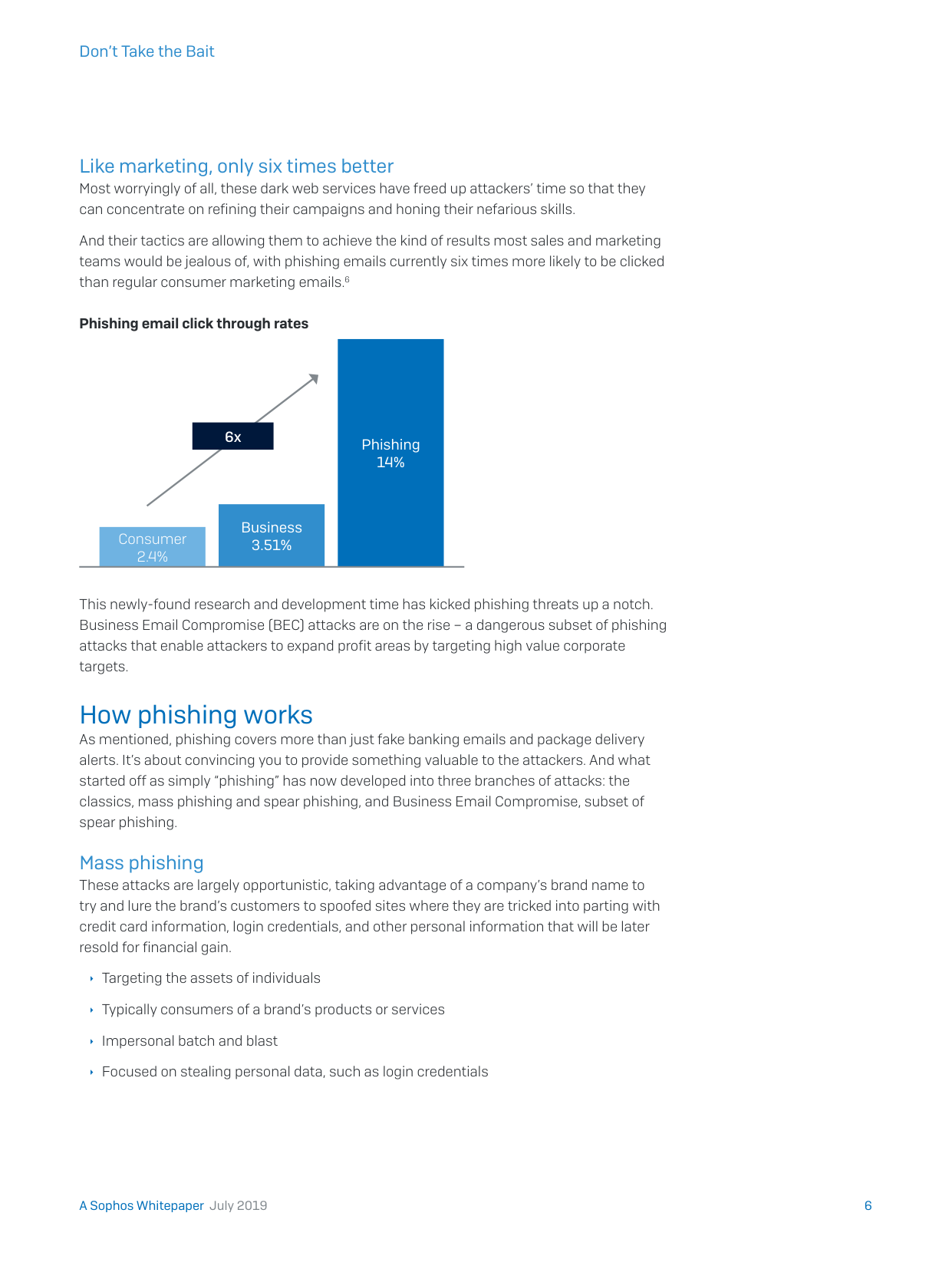
Ì Ransomware-as-a-service allow a user to create an online account and fill out a quick
web form, including the starting ransom price and a late payment price for victims. The
provider of the service then takes a cut of each ransom paid, with discounts offered if
the user is able to translate the malware code into new languages or if the volume of the
attack exceeds a certain level.
Satan ransomware - an online service allowing crooks to create their
own virus in minutes and start infecting Windows systems.
Ì Phishing-as-a-service allows users to pay for phishing attacks to be sent for them,
using global botnets to avoid known dodgy IP ranges. Guarantees are even made to
only bill users for delivered email messages, much like any legitimate email marketing
service.
Spam sending service example - priced per email sent to an activate
mailbox, with tracking even available on click-through rates.
These services have led to the explosion of phishing attacks highlighted earlier, as any
attacker can launch an attack regardless of technical skill.
Don’t Take the Bait
6
A Sophos Whitepaper July 2019
Like marketing, only six times better
Most worryingly of all, these dark web services have freed up attackers’ time so that they
can concentrate on refining their campaigns and honing their nefarious skills.
And their tactics are allowing them to achieve the kind of results most sales and marketing
teams would be jealous of, with phishing emails currently six times more likely to be clicked
than regular consumer marketing emails.6
Phishing email click through rates
Business
3.51%
Phishing
14%
Consumer
2.4%
6x
This newly-found research and development time has kicked phishing threats up a notch.
Business Email Compromise (BEC) attacks are on the rise – a dangerous subset of phishing
attacks that enable attackers to expand profit areas by targeting high value corporate
targets.
How phishing works
As mentioned, phishing covers more than just fake banking emails and package delivery
alerts. It’s about convincing you to provide something valuable to the attackers. And what
started off as simply “phishing” has now developed into three branches of attacks: the
classics, mass phishing and spear phishing, and Business Email Compromise, subset of
spear phishing.
Mass phishing
These attacks are largely opportunistic, taking advantage of a company’s brand name to
try and lure the brand’s customers to spoofed sites where they are tricked into parting with
credit card information, login credentials, and other personal information that will be later
resold for financial gain.
Ì Targeting the assets of individuals
Ì Typically consumers of a brand’s products or services
Ì Impersonal batch and blast
Ì Focused on stealing personal data, such as login credentials
Don’t Take the Bait
7
A Sophos Whitepaper July 2019
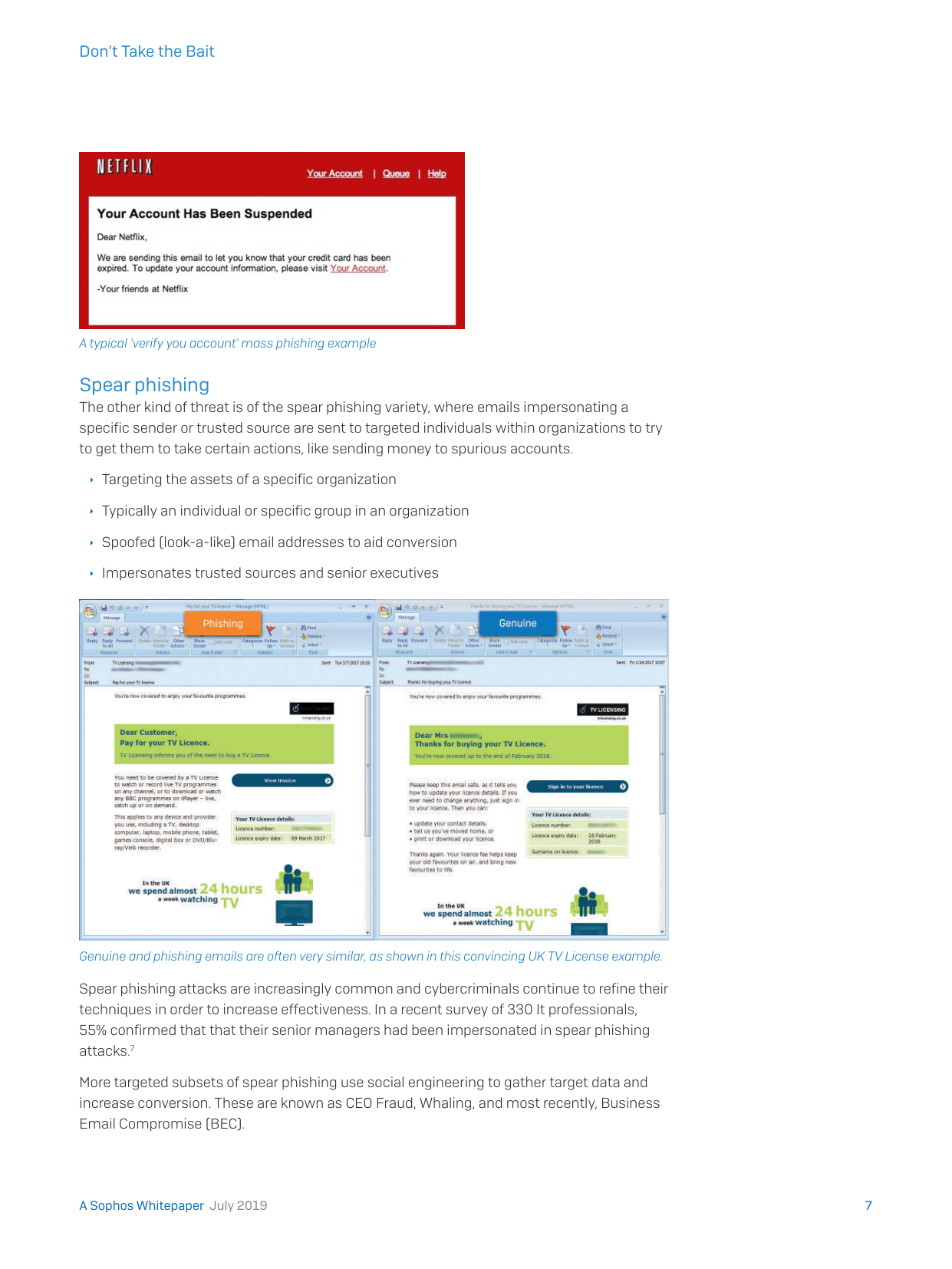
A typical 'verify you account' mass phishing example
Spear phishing
The other kind of threat is of the spear phishing variety, where emails impersonating a
specific sender or trusted source are sent to targeted individuals within organizations to try
to get them to take certain actions, like sending money to spurious accounts.
Ì Targeting the assets of a specific organization
Ì Typically an individual or specific group in an organization
Ì Spoofed (look-a-like) email addresses to aid conversion
Ì Impersonates trusted sources and senior executives
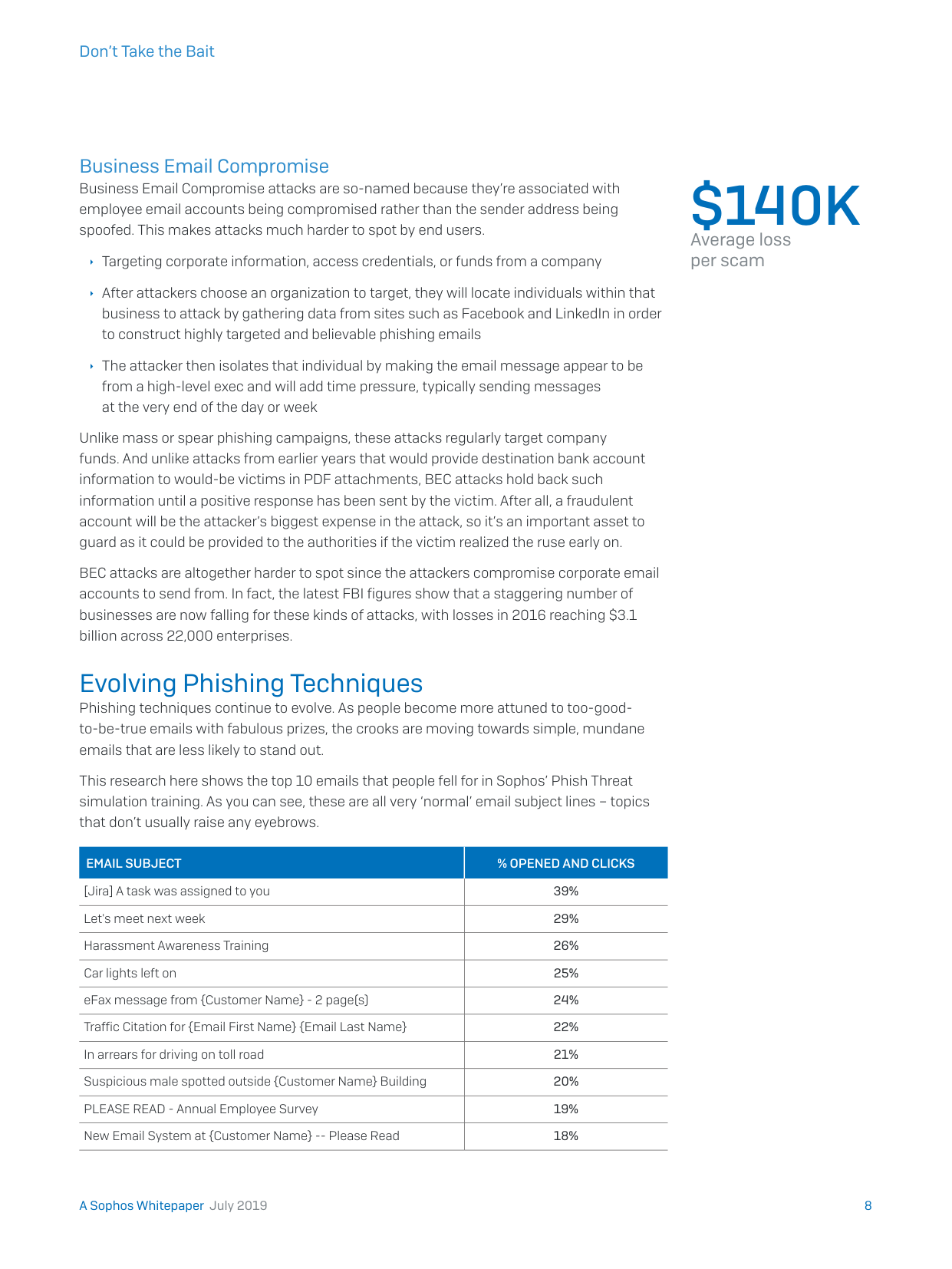
Genuine and phishing emails are often very similar, as shown in this convincing UK TV License example.
Spear phishing attacks are increasingly common and cybercriminals continue to refine their
techniques in order to increase effectiveness. In a recent survey of 330 It professionals,
55% confirmed that that their senior managers had been impersonated in spear phishing
attacks.7
More targeted subsets of spear phishing use social engineering to gather target data and
increase conversion. These are known as CEO Fraud, Whaling, and most recently, Business
Email Compromise (BEC).
Don’t Take the Bait
8
A Sophos Whitepaper July 2019
Business Email Compromise
Business Email Compromise attacks are so-named because they’re associated with
employee email accounts being compromised rather than the sender address being
spoofed. This makes attacks much harder to spot by end users.
Ì Targeting corporate information, access credentials, or funds from a company
Ì After attackers choose an organization to target, they will locate individuals within that
business to attack by gathering data from sites such as Facebook and LinkedIn in order
to construct highly targeted and believable phishing emails
Ì The attacker then isolates that individual by making the email message appear to be
from a high-level exec and will add time pressure, typically sending messages
at the very end of the day or week
Unlike mass or spear phishing campaigns, these attacks regularly target company
funds. And unlike attacks from earlier years that would provide destination bank account
information to would-be victims in PDF attachments, BEC attacks hold back such
information until a positive response has been sent by the victim. After all, a fraudulent
account will be the attacker’s biggest expense in the attack, so it’s an important asset to
guard as it could be provided to the authorities if the victim realized the ruse early on.
BEC attacks are altogether harder to spot since the attackers compromise corporate email
accounts to send from. In fact, the latest FBI figures show that a staggering number of
businesses are now falling for these kinds of attacks, with losses in 2016 reaching $3.1
billion across 22,000 enterprises.
Evolving Phishing Techniques
Phishing techniques continue to evolve. As people become more attuned to too-good-
to-be-true emails with fabulous prizes, the crooks are moving towards simple, mundane
emails that are less likely to stand out.
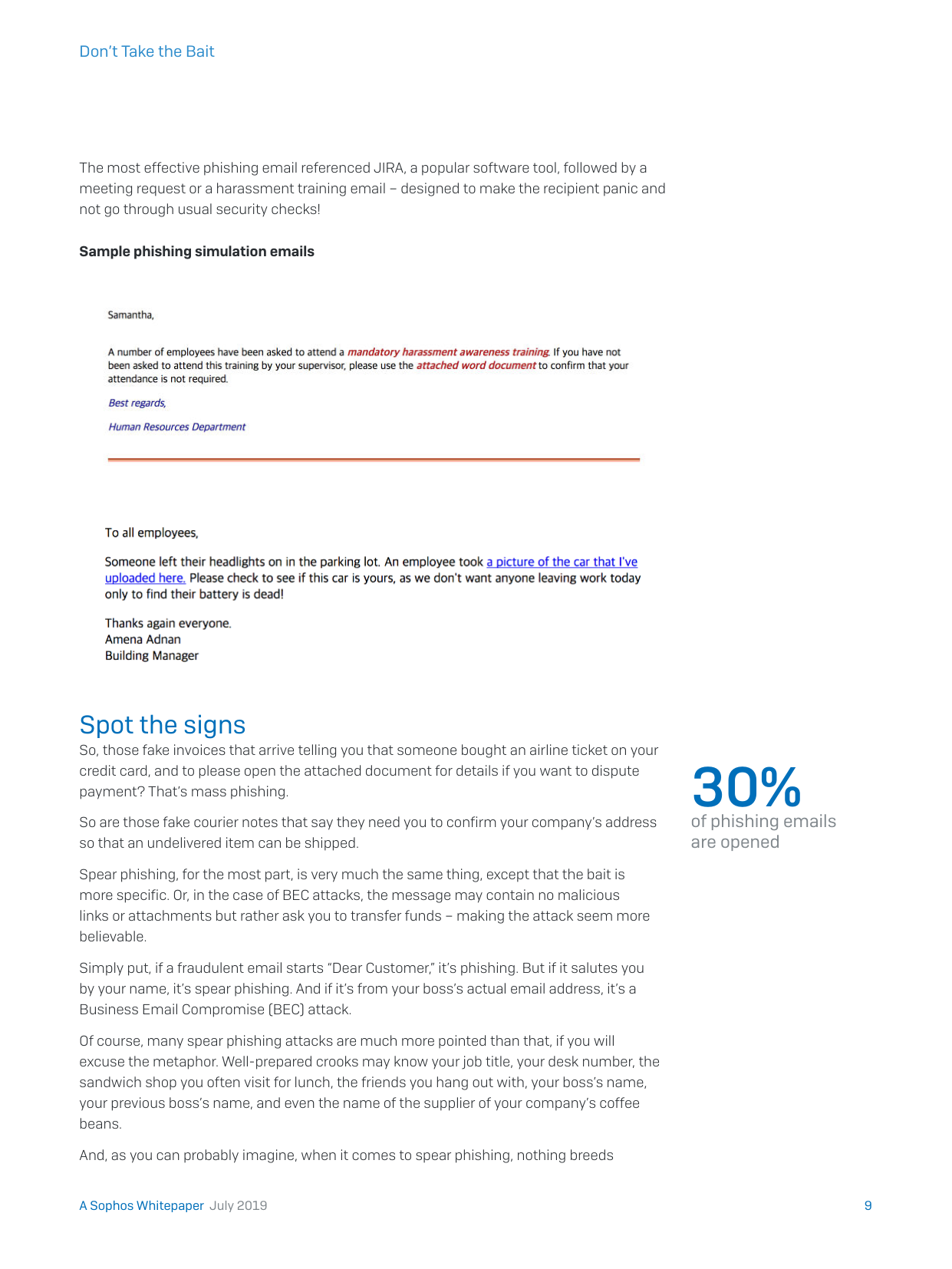
This research here shows the top 10 emails that people fell for in Sophos’ Phish Threat
simulation training. As you can see, these are all very ‘normal’ email subject lines – topics
that don’t usually raise any eyebrows.
EMAIL SUBJECT
% OPENED AND CLICKS
[Jira] A task was assigned to you
39%
Let's meet next week
29%
Harassment Awareness Training
26%
Car lights left on
25%
eFax message from {Customer Name} - 2 page(s)
24%
Traffic Citation for {Email First Name} {Email Last Name}
22%
In arrears for driving on toll road
21%
Suspicious male spotted outside {Customer Name} Building
20%
PLEASE READ - Annual Employee Survey
19%
New Email System at {Customer Name} -- Please Read
18%
$140K
Average loss
per scam
Don’t Take the Bait
9
A Sophos Whitepaper July 2019
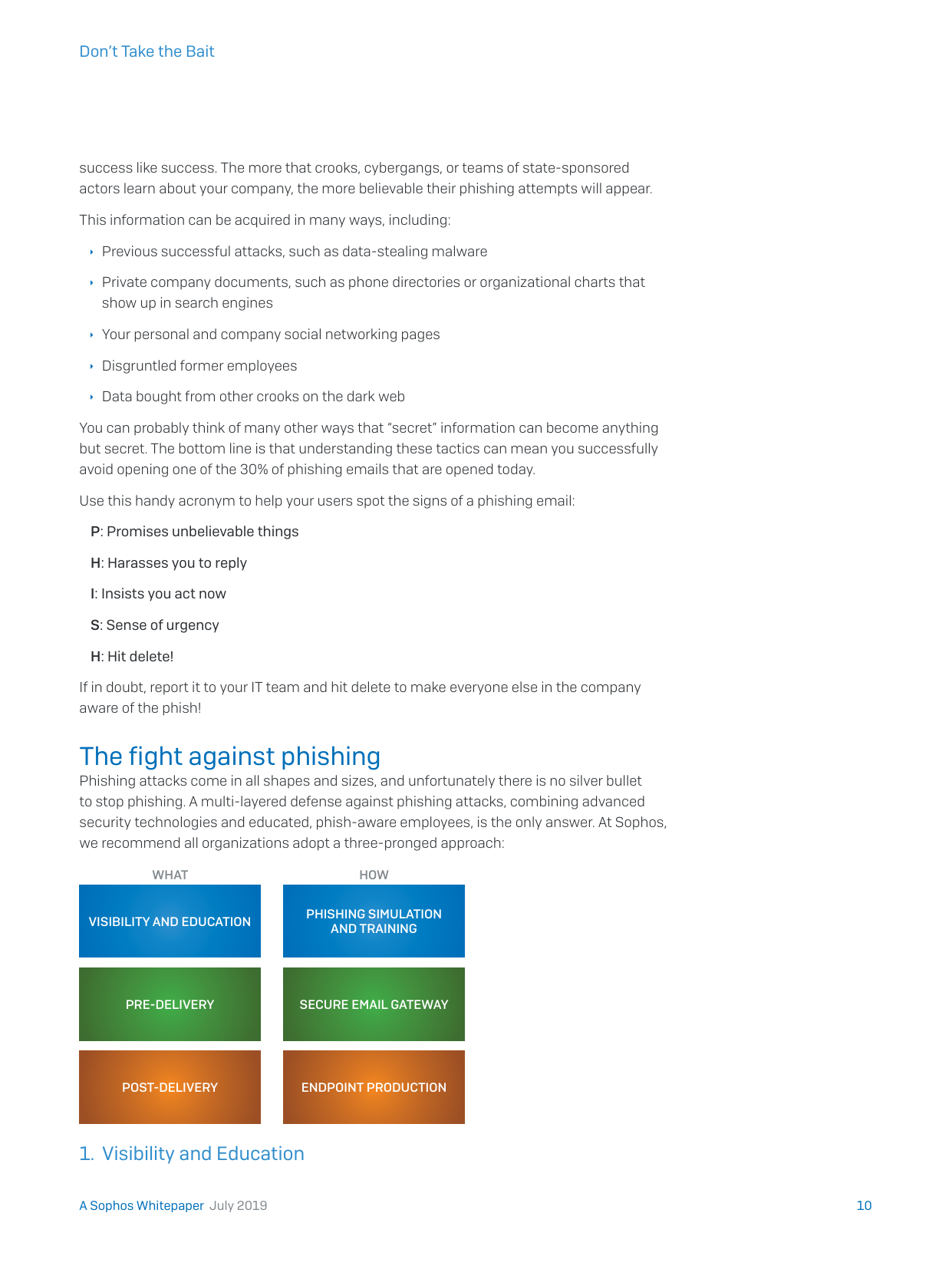
The most effective phishing email referenced JIRA, a popular software tool, followed by a
meeting request or a harassment training email – designed to make the recipient panic and
not go through usual security checks!
Sample phishing simulation emails
Spot the signs
So, those fake invoices that arrive telling you that someone bought an airline ticket on your
credit card, and to please open the attached document for details if you want to dispute
payment? That’s mass phishing.
So are those fake courier notes that say they need you to confirm your company’s address
so that an undelivered item can be shipped.
Spear phishing, for the most part, is very much the same thing, except that the bait is
more specific. Or, in the case of BEC attacks, the message may contain no malicious
links or attachments but rather ask you to transfer funds – making the attack seem more
believable.
Simply put, if a fraudulent email starts “Dear Customer,” it’s phishing. But if it salutes you
by your name, it’s spear phishing. And if it’s from your boss’s actual email address, it’s a
Business Email Compromise (BEC) attack.
Of course, many spear phishing attacks are much more pointed than that, if you will
excuse the metaphor. Well-prepared crooks may know your job title, your desk number, the
sandwich shop you often visit for lunch, the friends you hang out with, your boss’s name,
your previous boss’s name, and even the name of the supplier of your company’s coffee
beans.
And, as you can probably imagine, when it comes to spear phishing, nothing breeds
30%
of phishing emails
are opened
Don’t Take the Bait
10
A Sophos Whitepaper July 2019
success like success. The more that crooks, cybergangs, or teams of state-sponsored
actors learn about your company, the more believable their phishing attempts will appear.
This information can be acquired in many ways, including:
Ì Previous successful attacks, such as data-stealing malware
Ì Private company documents, such as phone directories or organizational charts that
show up in search engines
Ì Your personal and company social networking pages
Ì Disgruntled former employees
Ì Data bought from other crooks on the dark web
You can probably think of many other ways that “secret” information can become anything
but secret. The bottom line is that understanding these tactics can mean you successfully
avoid opening one of the 30% of phishing emails that are opened today.
Use this handy acronym to help your users spot the signs of a phishing email:
P: Promises unbelievable things
H: Harasses you to reply
I: Insists you act now
S: Sense of urgency
H: Hit delete!
If in doubt, report it to your IT team and hit delete to make everyone else in the company
aware of the phish!
The fight against phishing
Phishing attacks come in all shapes and sizes, and unfortunately there is no silver bullet
to stop phishing. A multi-layered defense against phishing attacks, combining advanced
security technologies and educated, phish-aware employees, is the only answer. At Sophos,
we recommend all organizations adopt a three-pronged approach:
VISIBILITY AND EDUCATION
PHISHING SIMULATION
AND TRAINING
PRE-DELIVERY
SECURE EMAIL GATEWAY
POST-DELIVERY
ENDPOINT PRODUCTION
WHAT
HOW
1. Visibility and Education
Don’t Take the Bait
11
A Sophos Whitepaper July 2019
In the fight against phishing, your users are the weakest link. In fact, it takes on average just
16 minutes for someone to click on a phishing email [Source: Verizon 2018 Data Breach
Investigation Report].
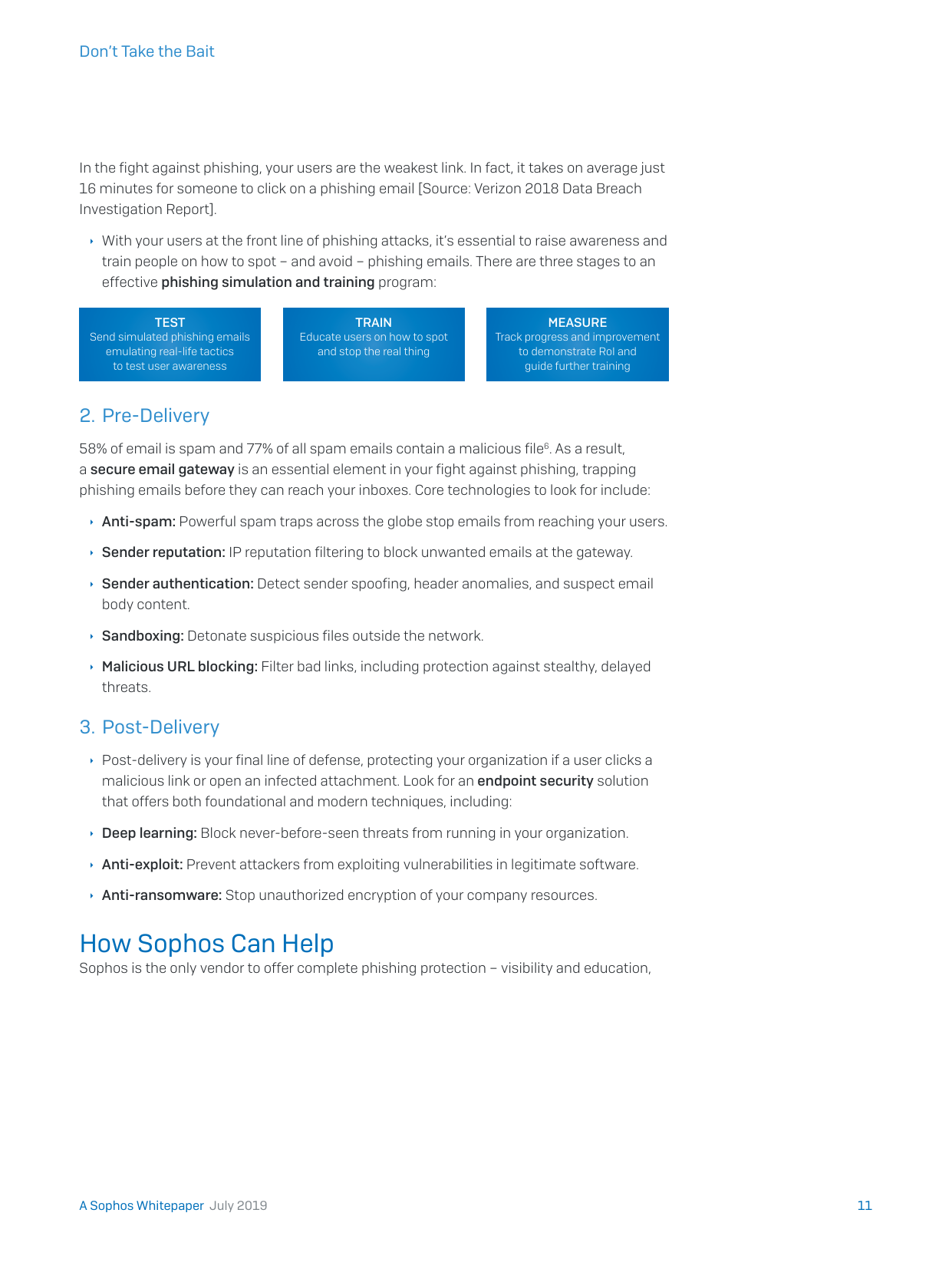
Ì With your users at the front line of phishing attacks, it’s essential to raise awareness and
train people on how to spot – and avoid – phishing emails. There are three stages to an
effective phishing simulation and training program:
TEST
Send simulated phishing emails
emulating real-life tactics
to test user awareness
TRAIN
Educate users on how to spot
and stop the real thing
MEASURE
Track progress and improvement
to demonstrate RoI and
guide further training
2. Pre-Delivery
58% of email is spam and 77% of all spam emails contain a malicious file6. As a result,
a secure email gateway is an essential element in your fight against phishing, trapping
phishing emails before they can reach your inboxes. Core technologies to look for include:
Ì Anti-spam: Powerful spam traps across the globe stop emails from reaching your users.
Ì Sender reputation: IP reputation filtering to block unwanted emails at the gateway.
Ì Sender authentication: Detect sender spoofing, header anomalies, and suspect email
body content.
Ì Sandboxing: Detonate suspicious files outside the network.
Ì Malicious URL blocking: Filter bad links, including protection against stealthy, delayed
threats.
3. Post-Delivery
Ì Post-delivery is your final line of defense, protecting your organization if a user clicks a
malicious link or open an infected attachment. Look for an endpoint security solution
that offers both foundational and modern techniques, including:
Ì Deep learning: Block never-before-seen threats from running in your organization.
Ì Anti-exploit: Prevent attackers from exploiting vulnerabilities in legitimate software.
Ì Anti-ransomware: Stop unauthorized encryption of your company resources.
How Sophos Can Help
Sophos is the only vendor to offer complete phishing protection – visibility and education,
Don’t Take the Bait
12
A Sophos Whitepaper July 2019
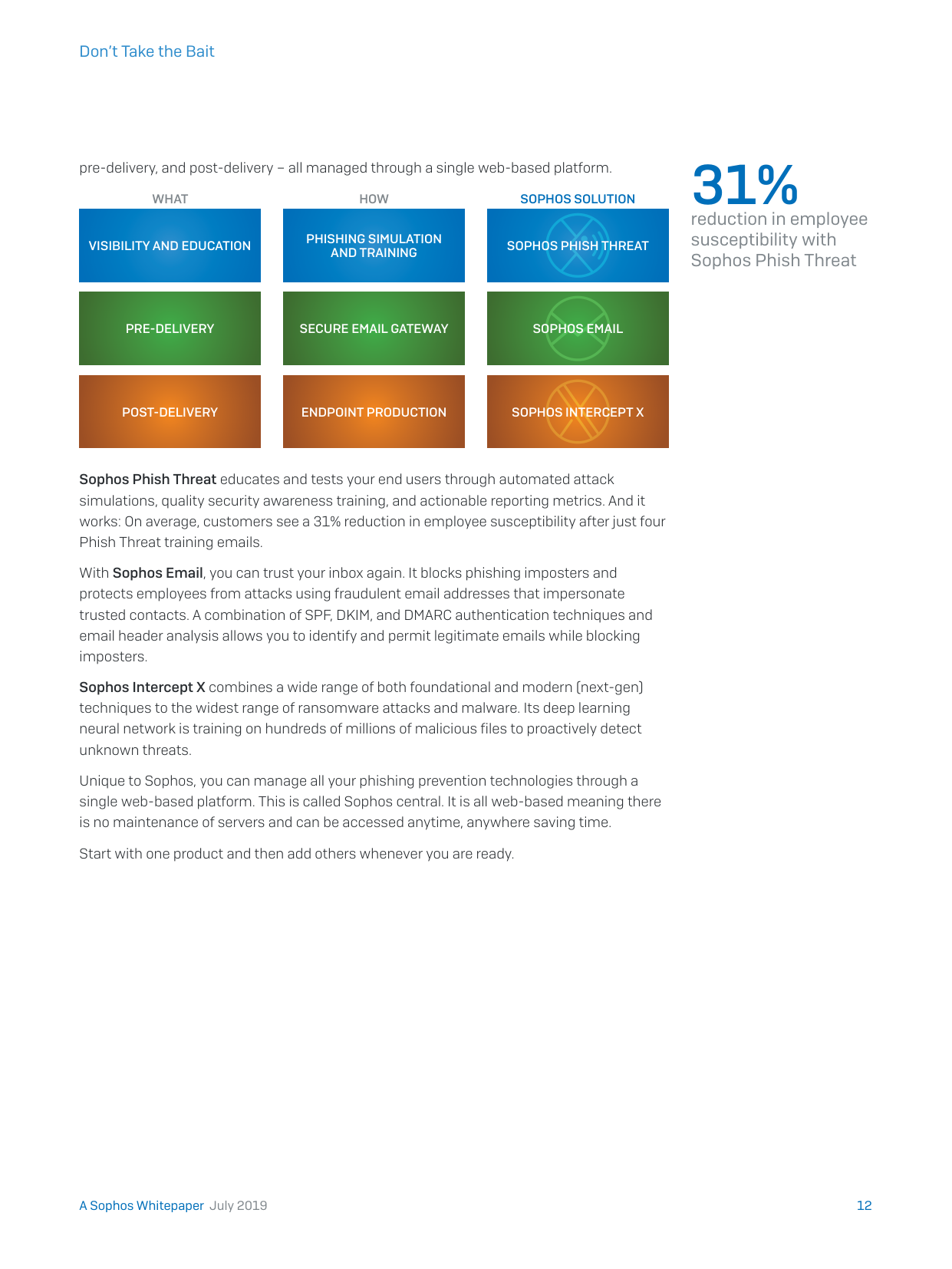
pre-delivery, and post-delivery – all managed through a single web-based platform.
VISIBILITY AND EDUCATION
PHISHING SIMULATION
AND TRAINING
PRE-DELIVERY
SECURE EMAIL GATEWAY
POST-DELIVERY
ENDPOINT PRODUCTION
WHAT
HOW
SOPHOS PHISH THREAT
SOPHOS EMAIL
SOPHOS INTERCEPT X
SOPHOS SOLUTION
Sophos Phish Threat educates and tests your end users through automated attack
simulations, quality security awareness training, and actionable reporting metrics. And it
works: On average, customers see a 31% reduction in employee susceptibility after just four
Phish Threat training emails.
With Sophos Email, you can trust your inbox again. It blocks phishing imposters and
protects employees from attacks using fraudulent email addresses that impersonate
trusted contacts. A combination of SPF, DKIM, and DMARC authentication techniques and
email header analysis allows you to identify and permit legitimate emails while blocking
imposters.
Sophos Intercept X combines a wide range of both foundational and modern (next-gen)
techniques to the widest range of ransomware attacks and malware. Its deep learning
neural network is training on hundreds of millions of malicious files to proactively detect
unknown threats.
Unique to Sophos, you can manage all your phishing prevention technologies through a
single web-based platform. This is called Sophos central. It is all web-based meaning there
is no maintenance of servers and can be accessed anytime, anywhere saving time.
Start with one product and then add others whenever you are ready.
31%
reduction in employee
susceptibility with
Sophos Phish Threat
Don’t Take the Bait
United Kingdom and Worldwide Sales
Tel: +44 (0)8447 671131
Email: sales@sophos.com
North American Sales
Toll Free: 1-866-866-2802
Email: nasales@sophos.com
Australia and New Zealand Sales
Tel: +61 2 9409 9100
Email: sales@sophos.com.au
Asia Sales
Tel: +65 62244168
Email: salesasia@sophos.com
© Copyright 2019. Sophos Ltd. All rights reserved.
Registered in England and Wales No. 2096520, The Pentagon, Abingdon Science Park, Abingdon, OX14 3YP, UK
Sophos is the registered trademark of Sophos Ltd. All other product and company names mentioned are
trademarks or registered trademarks of their respective owners.
2019-08-01 WP-UK (PC)
1, 3, 5, 7 Source: Phishing Temperature Check, Freeform Dynamics in association with The Register and Sophos, 2017
2 Source: Verizon 2018 Data Breach Investigations Report
4 The impossible puzzle of cybersecurity, Sophos, July 2019
6 Source: Verizon 2016 DBIR & Experian Email Benchmark Report Q4 2016
7 Source: SophosLabs, 2017